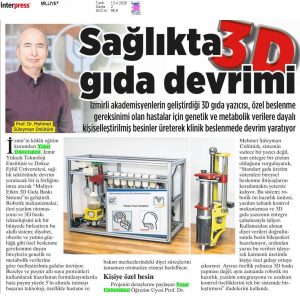
3D Printing for Personalized Nutrition
The 3D food printing system, developed in collaboration with Yaşar University, İzmir Institute of Technology, and Dokuz Eylül University, is opening the door to a new era—especially in clinical nutrition—by producing customized food tailored to individuals’ health conditions.
Developed through the joint effort of three universities in İzmir, the “Cost-Effective 3D Food Printing System” stands out as a groundbreaking technology in the field of personalized nutrition. By bringing together robotic systems, software automation, and extrusion-based 3D printing technology, the project can produce customized foods based on an individual’s genetic, metabolic, and health data.
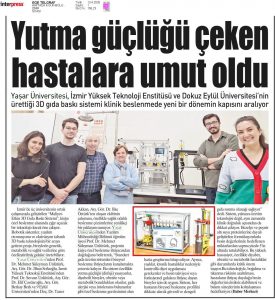
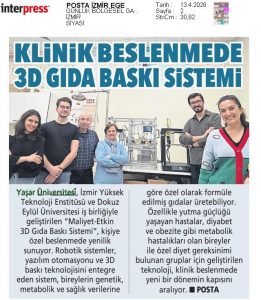
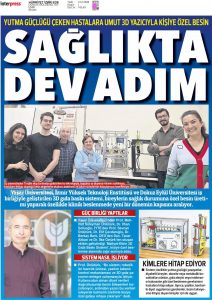
The work of the team—consisting of Prof. Dr. Mehmet Süleyman Ünlütürk and Research Assistant Dr. İlhan Sofuoğlu from Yaşar University; Prof. Dr. Sevcan Ünlütürk, Research Assistant Dr. Elif Çavdaroğlu, and Research Assistant Berkay Berk from the İzmir Institute of Technology; and Assoc. Prof. Dr. Taner Akkan and Research Assistant Dr. İlke Öztürk from Dokuz Eylül University—offers an innovative approach to health-focused nutritional solutions.
The system draws attention not only for its production technology but also for its clinical accuracy. Using formulations based on pea and whey proteins, the deviation from targeted nutritional values can be kept below 5%. This high precision is of critical importance, particularly for conditions such as diabetes, obesity, and metabolic diseases. The technology aims to reduce the risk of choking and swallowing difficulties, ensure that patients fully receive their required nutritional values, and facilitate overall care processes.
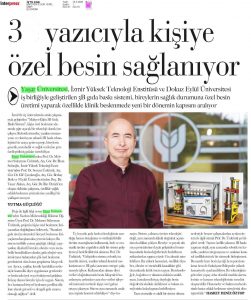
Highlighting how the system distinguishes itself from similar studies by being a fully automated and smart system, Prof. Dr. Ünlütürk provided the following details:
“Its distinguishing feature is not merely its 3D printing capability, but rather its ability to combine robotic pre-preparation, software integration, and remote control features into a single system. In this way, nutritional content, portioning, and functional components can all be adjusted with high precision. This technology could form the foundation of AI-supported kitchen systems and hospital technologies in the future. It has the potential to transform patient-centered nutrition processes in hospitals and care centers.”
Click here to access the news article prepared by our project partner, Yaşar University.